Next-generation AI for visually occult pancreatic cancer detection in a low-prevalence setting with longitudinal stability and multi-institutional generalisability
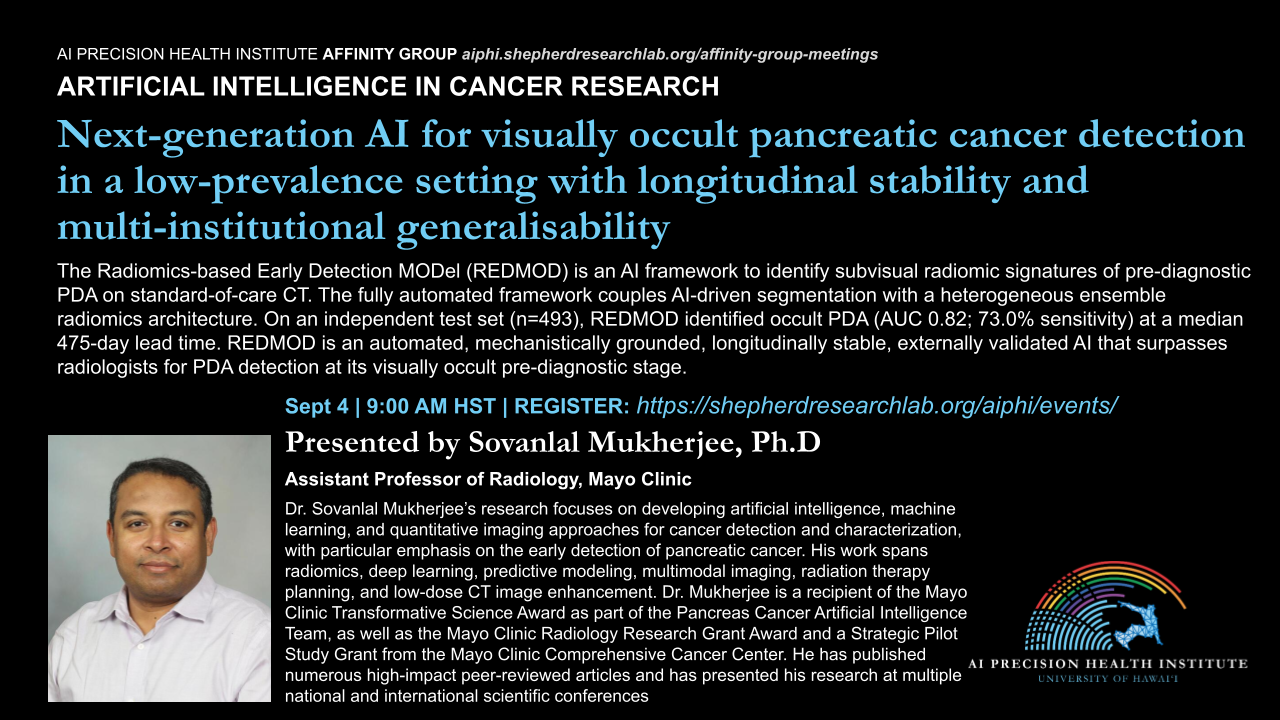
Sovanlal Mukherjee · PhD; Assistant Professor of Radiology, Mayo Clinic, Rochester, Minnesota
Failure of conventional imaging to detect pancreatic ductal adenocarcinoma (PDA) at its visually occult pre-diagnostic stage is a primary barrier to improving its otherwise poor survival. Over 85% of cases are diagnosed at an unresectable stage, and sporadic PDA — 85-90% of all cases — still has no recognised early detection strategy. This talk introduces REDMOD (Radiomics-based Early Detection MODel), a fully automated AI framework that identifies subvisual radiomic signatures of pre-diagnostic PDA on standard-of-care CT. REDMOD couples AI-driven volumetric pancreas segmentation with a heterogeneous ensemble classifier (logistic regression, random forest, XGBoost) trained on a 40-feature radiomic signature, and was deliberately validated in a low-prevalence setting (~6:1 control-to-case ratio) that reflects real early-detection cohorts rather than the balanced case-control designs used in earlier work.
On an independent test set of 493 scans, REDMOD detected occult PDA with an AUC of 0.82 and 73.0% sensitivity at a median lead time of 475 days before clinical diagnosis — nearly twice the sensitivity of board-certified radiologists (38.9%), widening to nearly threefold (68.0% vs 23.0%) for scans acquired more than 24 months before diagnosis. The model held 90-92% test-retest concordance across serial scans and generalised its specificity to independent multi-institutional (81.3%, n=539) and public NIH-PCT (87.5%, n=80) cohorts. Mechanistically, 90% of the selected signature came from multi-scale wavelet-filtered textural features, which significantly outperformed unfiltered features (AUC 0.82 vs 0.74) — suggesting the earliest detectable manifestations of PDA are subtle, diffuse architectural disruptions rather than any discrete mass. The work appears in Gut (2026).